42. Trapping Rain Water
Hard
Array Two Pointers Dynamic Programming Stack Monotonic Stack
Given n non-negative integers representing an elevation map where the width of each bar is 1, compute how much water it can trap after raining.
Example 1:
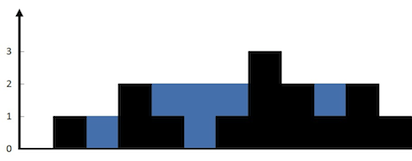
Input: height = [0,1,0,2,1,0,1,3,2,1,2,1]
Output: 6
Explanation: The above elevation map (black section) is represented by array [0,1,0,2,1,0,1,3,2,1,2,1]. In this case, 6 units of rain water (blue section) are being trapped.
Example 2:
Input: height = [4,2,0,3,2,5]
Output: 9
Constraints:
n == height.length1 <= n <= 2 * 10^40 <= height[i] <= 10^5
func trap(height []int) int {
	m := math.MinInt
	for _, n := range height {
		m = max(m, n)
	}

	prevMax := make([]int, len(height))
	prevMax[0] = height[0]
	for x := 1; x < len(height); x++ {
		prevMax[x] = max(prevMax[x-1], height[x])
	}
	// fmt.Println("prevMax", prevMax)

	nextMax := make([]int, len(height))
	nextMax[len(height)-1] = height[len(height)-1]
	for x := len(height) - 2; x >= 0; x-- {
		nextMax[x] = max(nextMax[x+1], height[x])
	}
	// fmt.Println("nextMax", nextMax)

	result := 0
	for x := 1; x < len(height)-1; x++ {
		pn := prevMax[x-1]
		nn := nextMax[x+1]
		mm := min(pn, nn)
		if mm > height[x] {
			result += mm - height[x]
		}
	}
	return result
}